









Sun and Moon Observational Data
Sun |
Earth |
Moon |
|
|
 |
|
| Sunrise: 05:46 Sunset: 20:21 Daylight: 14:35:00 |
Current Sunlit Earth With Live Cloud Cover |
Moonrise: 23:51 Moonset: 06:52 Waning Gibbous Moon 88% Illuminated |

| First Quarter Moon | Full Moon | Last Quarter Moon | New Moon |
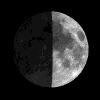 |
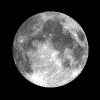 |
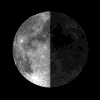 |
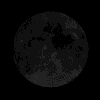 |
|
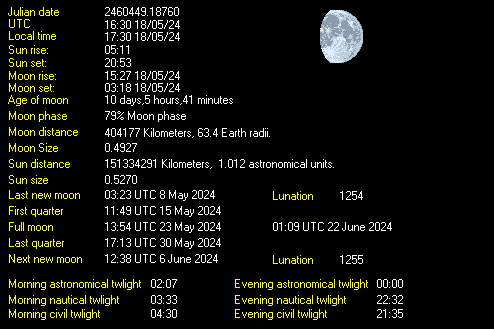
15/04/2024 20:14 19:14 UTC 15 April 2024 |
24/04/2024 00:50 23:50 UTC 23 April 2024 |
01/05/2024 12:28 11:28 UTC 1 May 2024 |
08/05/2024 04:23 03:23 UTC 8 May 2024 |
| Vernal Equinox Start of Spring |
Summer Solstice Start of Summer |
Autumn Equinox Start of Autumn |
Winter Solstice Start of Winter |
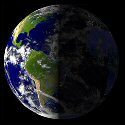 |
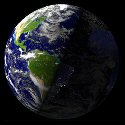 |
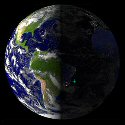 |
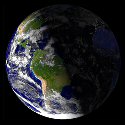 |
|
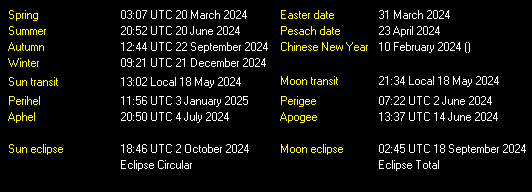
20/03/2024 03:07 03:07 UTC 20 March 2024 |
20/06/2024 21:52 20:52 UTC 20 June 2024 |
22/09/2024 13:44 12:44 UTC 22 September 2024 |
21/12/2024 09:21 09:21 UTC 21 December 2024 |
Current Position of Day and Night Regions - World Sunlight Map
The World Sunlight Map provides a computer-generated approximation of what the earth currently looks like.
While less impressive than actually being into orbit, this is much more accessible to most of us.
We start with cloudless images of the earth during the day (from a pair of NASA satellites) and night (from a DoD program to map city lights). Every 3 hours, we download a composite cloud image based on data from weather satellites all over the world. And every half hour, these images are composited and mapped onto a sphere by xplanet according to the relative position of the sun. The flat maps are post-processed by ImageMagick to cut off the 15 degrees nearest the north and south poles where cloud data is unavailable.
Composite Image of the Moon - Current Phase Map
Moon Phase provides a computer-generated approximation of what the moon currently looks like.
While less impressive than the real thing, it doesn't require waiting for a cloudless night.
It is based on a composite image of the moon made up of data from various satellites. Every hour, this image is mapped onto a sphere and shaded by xplanet according to the current positions of the earth and moon, then post-processed by ImageMagick to remove some visible artifacts.