





Thunderstorms and Lightning
Every thunderstorm, by definition, produces lightning — a discharge of electricity built up between oppositely charged regions of the storm, or between the storm and the ground. The spark itself heats the surrounding air to roughly 30,000°C in a fraction of a second, several times hotter than the surface of the sun, and that near-instant heating and re-cooling makes the air violently expand and then contract. It's that shock wave, not the electrical discharge itself, that we hear as thunder — and at close range, the same shock wave is strong enough to rattle windows or crack glass.
The Three-Stage Life Cycle
Every thunderstorm cell, however large the overall system it's part of, passes through the same three stages over roughly 30 minutes:


Diagrams: NOAA / National Weather Service JetStream — Online School for Weather.
How a Storm Cloud Gets Charged
Inside a mature storm, rising and falling ice crystals and hail collide constantly, and those collisions transfer electrical charge. Lighter ice crystals tend to pick up a positive charge and get carried upward by the storm's updraft, while heavier hail picks up a negative charge and sinks toward the lower part of the cloud. The result is a storm with a positively charged top and a negatively charged base — and because the ground beneath is normally very slightly negatively charged, the negative charge building up low in the storm induces a positive charge on the ground directly underneath, which tracks the storm like a shadow as it moves.
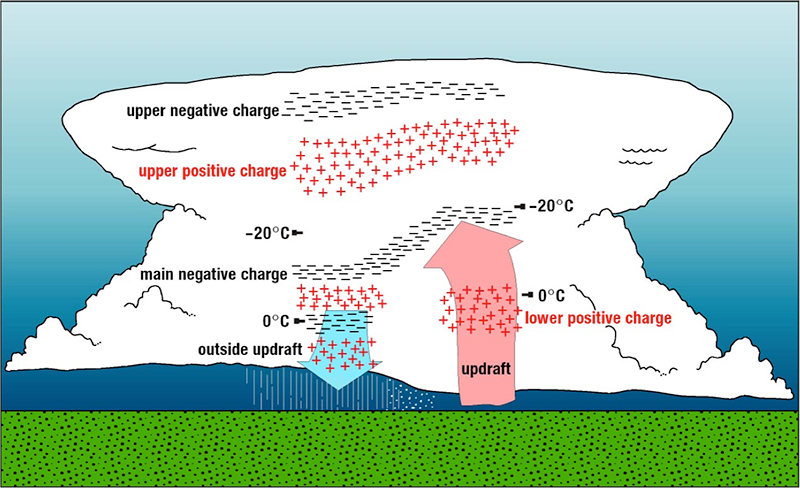
Negative and Positive Flashes
Once the electrical potential between two oppositely charged regions grows large enough to overcome air's natural insulation, a lightning discharge occurs. Most cloud-to-ground lightning is a "negative flash", running between the negatively charged storm base and the positive charge on the ground beneath it: a faint, negatively-charged "step leader" feels its way down from the cloud, and as it nears the ground, positive streamers rise up to meet it from trees, buildings and other tall objects; the instant they connect, a bright return stroke of current surges up the channel, which is the visible flash. "Positive flashes" work the same way in reverse, originating higher up in the positively-charged anvil rather than the cloud base. They are far less common, but because the anvil is so much further from the ground, a positive flash needs a much larger charge to bridge the gap, and consequently tends to be far more powerful, and far more dangerous, than an ordinary negative flash.
Why Positive Flashes Catch People Out
Because the anvil can extend a long way beyond the rain-bearing core of the storm, positive flashes often strike well outside the area where rain is falling and where most of the storm's ordinary lightning and thunder is occurring — sometimes miles from the visible storm cell itself. This is exactly why people are caught off guard by lightning on what feels like a clear, dry patch of ground some distance from the main storm. The standard safety advice reflects this: get to shelter early and stay there well after the rain has passed, because if you can hear thunder at all, you're within range of the next strike.
Timing the Distance
Light from a lightning flash reaches you almost instantly, but sound travels at only around 343 metres (1,125ft) per second, roughly a mile every 5 seconds. Counting the seconds between the flash and the thunder and dividing by five gives a rough distance in miles to that particular stroke — ten seconds means the flash was about two miles away, fifteen seconds about three miles. It only tells you about the flash that's already happened, though, not where the next one will strike, which is exactly why the count should never be used to judge whether it's safe to stay outside.
Thunderstorms Around Southampton
UK thunderstorms are generally less frequent and less intense than the storms found over continental interiors or the central United States, mainly because the surrounding sea keeps air masses here more stable. Most Southampton-area storms fall into one of two patterns: slow-moving summer storms that build locally on hot, humid afternoons after a spell of settled weather, and frontal storms embedded within a larger Atlantic low-pressure system, which tend to move through faster but can arrive at any time of year. Both types can still produce the full range of hazards described above, so the same flash-to-bang guidance applies here just as anywhere else.